Tune sources
Here we demonstrate included utilities for loading tune data.
from pyabc2.sources import load_example, norbeck, the_session
abcjs loaded
A few examples are included in the package, accessible with pyabc2.sources.load_example() (returns Tune) and pyabc2.sources.load_example_abc() (returns ABC string).
load_example("For the Love of Music")
Tune(title='For The Love Of Music', key=Gmaj, type='slip jig')
The tune source modules, demonstrated below, download tune data from the internet.
Norbeck
norbeck.load() gives us a list of Tunes for one of Norbeck’s tune type groups (e.g. ‘jigs’, ‘reels’, ‘slip jigs’).
tunes = norbeck.load("jigs")
print(len(tunes), "jigs loaded")

tunes[0]
downloading...
done
540 jigs loaded
Tune(title="Bride's Favourite, The", key=Gmaj, type='jig')
tunes[-1]
Tune(title='30-årsjiggen', key=Gmaj, type='jig')
The Session
the_session.load() gives us a list of Tunes loaded from a (frequently updated) archive of all of the tunes in The Session. This is a large dataset, so here we cap the processing.
tunes = the_session.load(n=500)

tunes[0]
downloading...
done
/home/docs/checkouts/readthedocs.org/user_builds/pyabc2/envs/v0.1.0/lib/python3.11/site-packages/pyabc2/sources/the_session.py:306: UserWarning: 20 out of 500 The Session tune(s) failed to load. Enable logging debug messages to see more info.
  warnings.warn(msg)
Tune(title='$150 Boot, The', key=Gmaj, type='polka')
tunes[-1]
Tune(title='A Trip To The Cottage', key=Gmaj, type='jig')
tune = the_session.load_url("https://thesession.org/tunes/21799#setting43712")
tune
Tune(title='The Cherrytree', key=Gmaj, type='jig')
tune.print_measures()
01: G2 d c B G
02: G F G A F D
03: G2 d A G G
04: d e e f g g
05: G2 d c B G
06: G F G A F D
07: B c c g2 B
08: B c g a f d
09: G2 d c B G
10: G F G A F D
11: G2 d A G G
12: d e e f g g
13: G2 d c B G
14: G F G A F D
15: B c c e2 B
16: A G E G A F
17: E B e d B e
18: d e g d B e
19: f B g f B f
20: f g g g a a
21: g a f f g e
22: f g d e d B
23: B d e f g A
24: A B d A G F
25: E B e d B e
26: d e g d B e
27: f B g f B f
28: f g g g a a
29: b2 a a g e
30: f g e e d e
31: d f a e d e
32: d B A A G F
Data archive
The Session data archive (https://github.com/adactio/TheSession-data) has many datasets (pyabc2.sources.the_session.load_meta()),
which we can use in other ways besides parsing ABCs to Tunes.
For example, we can look for the most common ABC notes in the corpus.
%%time

df = the_session.load_meta("tunes", convert_dtypes=True)
df
CPU times: user 502 ms, sys: 236 ms, total: 737 ms
Wall time: 660 ms
| tune_id | setting_id | name | type | meter | mode | abc | date | username | |
|---|---|---|---|---|---|---|---|---|---|
| 0 | 18105 | 35234 | $150 Boot, The | polka | 2/4 | Gmajor | |:d>g fe|dB AG|E/F/G E/F/G|BA GF| d>g fe|dB A... | 2019-07-06 04:39:09 | NfldWhistler |
| 1 | 11931 | 11931 | 'G Iomain Nan Gamhna | slip jig | 9/8 | Gmajor | dBB B2 A BAG|dBB Bcd efg|dBB B2 A BAG|eAA dBG ... | 2012-05-17 07:49:26 | iliketurtles |
| 2 | 11931 | 48772 | 'G Iomain Nan Gamhna | slip jig | 9/8 | Amixolydian | |:dBB BBA BAG|dBB Bcd efg|dBB BBA BAG|e2A dBG ... | 2023-11-25 22:54:00 | birlibirdie |
| 3 | 15326 | 28560 | 'S Ann An Ìle | strathspey | 4/4 | Gmajor | |:G>A B>G c>A B>G|E<E A>G F<D D2|G>A B>G c>A B... | 2016-03-31 15:34:45 | danninagh |
| 4 | 15326 | 28582 | 'S Ann An Ìle | strathspey | 4/4 | Gmajor | uD2|:{F}v[G,2G2]uB>ud c>A B>G|{D}E2 uA>uG F<D ... | 2016-04-03 09:15:08 | DonaldK |
| ... | ... | ... | ... | ... | ... | ... | ... | ... | ... |
| 51760 | 13875 | 24924 | Zuppa Inglese | jig | 6/8 | Gmajor | GAG GAB|cBc cde|d2B GAB|A2G E2D| GAG GAB|cBc ... | 2014-10-07 22:55:26 | Edward Nunn |
| 51761 | 6040 | 6040 | Ølland | waltz | 3/4 | Gmajor | AB|:c2 cd cB|A2 AB cd|e2 g2 f2|1 e4 AB:|2 e4 e... | 2006-07-28 15:19:26 | Kuddel |
| 51762 | 6040 | 17944 | Ølland | waltz | 3/4 | Ddorian | F2 FG FE|D2 DE FG|A2 c2- cB|A4-:| A2 FA FA|F2... | 2006-07-30 13:32:55 | ceolachan |
| 51763 | 6040 | 39239 | Ølland | waltz | 3/4 | Adorian | |:AB|c2 cd Bc|A3 B cd|e2 g2 f2|e4:| w:Var det... | 2020-10-11 19:23:21 | janglecrow |
| 51764 | 6040 | 39240 | Ølland | waltz | 3/4 | Aminor | AB|"Am"c2 cd "G"Bc|"Am"A3 B cd|"Em"e2 g2 "D"^f... | 2020-10-11 19:47:57 | Bazza |
51765 rows × 9 columns
df.info()
<class 'pandas.core.frame.DataFrame'>
RangeIndex: 51765 entries, 0 to 51764
Data columns (total 9 columns):
 #   Column      Non-Null Count  Dtype
---  ------      --------------  -----
 0   tune_id     51765 non-null  Int64
 1   setting_id  51765 non-null  Int64
 2   name        51765 non-null  string
 3   type        51765 non-null  category
 4   meter       51765 non-null  category
 5   mode        51765 non-null  category
 6   abc         51765 non-null  string
 7   date        51765 non-null  datetime64[ns]
 8   username    51765 non-null  string
dtypes: Int64(2), category(3), datetime64[ns](1), string(3)
memory usage: 2.6 MB
from pyabc2.note import _RE_NOTE as rx

rx
re.compile(r"(?P<acc>\^|\^\^|=|_|__)?(?P<note>[a-gA-G])(?P<oct>[,']*)(?P<num>[0-9]+)?(?P<slash>/+)?(?P<den>[0-9]+)?",
           re.UNICODE)
This regular expression does also match letters in tune titles, say.
["".join(tup) for tup in rx.findall("the quick brown fox jumps over the lazy dog")]
['e', 'c', 'b', 'f', 'e', 'e', 'a', 'd', 'g']
But The Session stores the tune body separately (in the abc field) and encourages a bare-bones melody-focused approach, so we can expect to mostly be matching actual notes.
from pprint import pprint

cool = df.query("tune_id == 1 and setting_id == 1")
display(cool.T)

abc = cool.abc.iloc[0]
print(abc, "\n")

pprint([m.group() for m in rx.finditer(abc)], compact=True)
| 9760 | |
|---|---|
| tune_id | 1 |
| setting_id | 1 |
| name | Cooley's |
| type | reel |
| meter | 4/4 |
| mode | Edorian |
| abc | |:D2|EBBA B2 EB|B2 AB dBAG|FDAD BDAD|FDAD dAFD... |
| date | 2001-05-14 18:45:18 |
| username | Jeremy |
|:D2|EBBA B2 EB|B2 AB dBAG|FDAD BDAD|FDAD dAFD|
EBBA B2 EB|B2 AB defg|afec dBAF|DEFD E2:|
|:gf|eB B2 efge|eB B2 gedB|A2 FA DAFA|A2 FA defg|
eB B2 eBgB|eB B2 defg|afec dBAF|DEFD E2:|

['D2', 'E', 'B', 'B', 'A', 'B2', 'E', 'B', 'B2', 'A', 'B', 'd', 'B', 'A', 'G',
 'F', 'D', 'A', 'D', 'B', 'D', 'A', 'D', 'F', 'D', 'A', 'D', 'd', 'A', 'F', 'D',
 'E', 'B', 'B', 'A', 'B2', 'E', 'B', 'B2', 'A', 'B', 'd', 'e', 'f', 'g', 'a',
 'f', 'e', 'c', 'd', 'B', 'A', 'F', 'D', 'E', 'F', 'D', 'E2', 'g', 'f', 'e',
 'B', 'B2', 'e', 'f', 'g', 'e', 'e', 'B', 'B2', 'g', 'e', 'd', 'B', 'A2', 'F',
 'A', 'D', 'A', 'F', 'A', 'A2', 'F', 'A', 'd', 'e', 'f', 'g', 'e', 'B', 'B2',
 'e', 'B', 'g', 'B', 'e', 'B', 'B2', 'd', 'e', 'f', 'g', 'a', 'f', 'e', 'c',
 'd', 'B', 'A', 'F', 'D', 'E', 'F', 'D', 'E2']
%%time

note_counts = (
    df.abc
    .str.findall(rx)
    .explode()
    .str.join("")
    .value_counts()
)
note_counts
CPU times: user 3.53 s, sys: 490 ms, total: 4.02 s
Wall time: 4.01 s
A       697004
d       639421
B       632183
e       532800
c       432596
         ...
B2/4         1
e2//         1
^F,6         1
=F,2         1
=B,6         1
Name: abc, Length: 992, dtype: int64
note_counts[:20]
A     697004
d     639421
B     632183
e     532800
c     432596
G     426832
f     375519
F     302322
g     291114
E     254752
D     218108
a     195243
A2     92854
d2     90330
B2     76674
G2     72472
e2     57654
b      57430
c2     45618
C      42239
Name: abc, dtype: int64
👆 We can see that A (unit duration) is the leader, being a prominent pitch in many of the common keys.
5 in Dmaj
2 in Gmaj
1 in Ador, Amin, Amix, Amaj
Note
A implies A₄, the A above middle C, the A string on a violin, the lower register on the flute, etc.
Note
In general we don’t know the duration of A without context (L: header field, or based on M: if L: is not set).
However, in this case, we know that the The Session presets the unit duration to 1/8,
so A is an eighth note.
from textwrap import wrap

print("\n".join(wrap("  ".join(note_counts[note_counts == 1].index))))
b'2  _f4  b,,3  ^c,2  ^B,2  c'3/4  e''  =F,  E5/2  f5/2  f'/2  B,1
D,1  =F,3  =F,,3  E,,3  _B,3/2  =G6  ^G'  A/1  =B/4  G/1  B,//  _a4
e,2  f/8  ^g/8  =c'4  _c'  E75  =C,  e'1  ^f2/3  ^c2/  A11  e2/4  A6//
^a//  F////  F///  A4/3  ^A10  ^a8  _A,6  d6/  ^b/  D11  C6/  ^D/2
B,'  f,3  D2/3  =c2/3  =A4  d1/3  a'/  ^G10  ^D6  ^D10  ^D8  A,12
^c'4  ^c'3  =A/4  g,/  d16  =c16  E24  _d/  E33  d'/4  ^A3/4  ^B3/4
f,8  =D6  e8/3  a8/3  c'1/2  c,3  C,12  A7/9  A16  ^^D4  ^^d4  ^^d3
^^D  A,9  _d'3  e'3/2  ^f'2  G'4  F'3  =a3  A'4  D22  c7  a/3  B16
G16  A'/  a'4  e4/  f4/  =e//  ^g/2  ^A//  D/8  E/8  B/8  F5/  _a3/2
G,12  _e8  =c'3/2  ^e/2  ^A5  _E,2  G,,4  _g/  g,,2  B32  e23  ^E,2
B'/2  F,6  E,8  c3//  D'/  C'/  =c1  _d6  B7/4  _c3  =e6  B11  _e'/
__d  d14  _c'2  ^f/2  ^b4  D''  f9/  _G4  c9  _A4  =G8  F5/4  B4/
A2/4  B2/4  e2//  ^F,6  =F,2  =B,6
👆 A variety of ABC note specs appear only once. Many of these have unusual durations or accidentals.
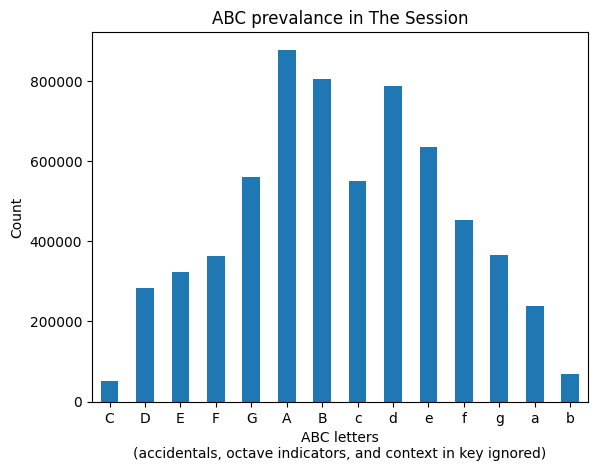
What if we ignore everything except the natural note name?
nat_cased_counts = (
    note_counts
    .reset_index(drop=False)
    .rename(columns={"index": "note", "abc": "count"})
    .assign(nat=lambda df: df.note.str.extract(r"([a-gA-G])"))
    .groupby("nat")
    .aggregate({"count": "sum"})["count"]
    .sort_values(ascending=False)
)
nat_cased_counts
nat
A    879349
B    804463
d    789330
e    634971
G    561676
c    551252
f    452672
g    366401
F    363493
E    324053
D    283423
a    239413
b     68184
C     51871
Name: count, dtype: int64
👆 A is still our leader, but otherwise things have shifted a bit.
Note C, which generally implies a pitch outside of the range of most whistles and flutes,
has the lowest count.
Although b is inside that range, many tunes don’t have one.
from pyabc2 import Note

(
    nat_cased_counts
    .to_frame()
    .assign(value=lambda df: df.index.map(lambda x: Note.from_abc(x).value))
    .sort_values("value")["count"]
    .plot.bar(
        xlabel="ABC letters\n(accidentals, octave indicators, and context in key ignored)",
        rot=0,
        ylabel="Count",
        title="ABC prevalance in The Session",
    )
);